



 Ganbare! Nakamura-kun!! is a stranger series than it appears superficially to be. In the first place it’s a two-volume manga stretched out to 13 episodes, which means it’s radically reworked and full of original material. It’s also a series that I would argue trades very heavily on its universality for its success. As a chronicle of what it’s like to be young and hopelessly in love with someone, I can think of very few anime or manga which equal it. Yet the core conceit of the story is not universal, but very specific. And that element invites some questions that, up to now, haven’t gotten much attention.
 As it happens, the matter that was central to this (superb) episode is one that’s been much on my kind with Nakamura-kun. I had a conversation about it just a couple days ago in fact – coincidentally, but in the knowledge that it had to be addressed in the final two episodes, I suppose. I’ve written before about how Hirose is objectified in the narrative, very much by design. He’s not a character so much as Nakamura’s image of a character. I would love to see an episode from Hirose’s perspective – he’s fascinating, because Nakamura’s image of him is fascinating. But that would probably shatter the whole illusion. On some level that’s a flaw, but if it weren’t the case I don’t know if you have a story.
 Yes, this was the biggest elephant in the room for me. What has Nakamura-kun been thinking or imagining about Hirose-kun’s orientation? Not being gay, there are limitations with how much I can identify with his situation – no matter how universal I find the story as a whole. He has to know, intellectually, that the odds aren’t great. Hirose has given him absolutely no indication (unless you call his man-crush on Otogiri-sensei a romantic one) that he’s interested in guys. Does he assume Hirose must be gay, otherwise he wouldn’t vibe with him so closely? Does he fear the worst but refuse to let himself believe it? Is he just happy being around Hirose, even if it can never be more than that?
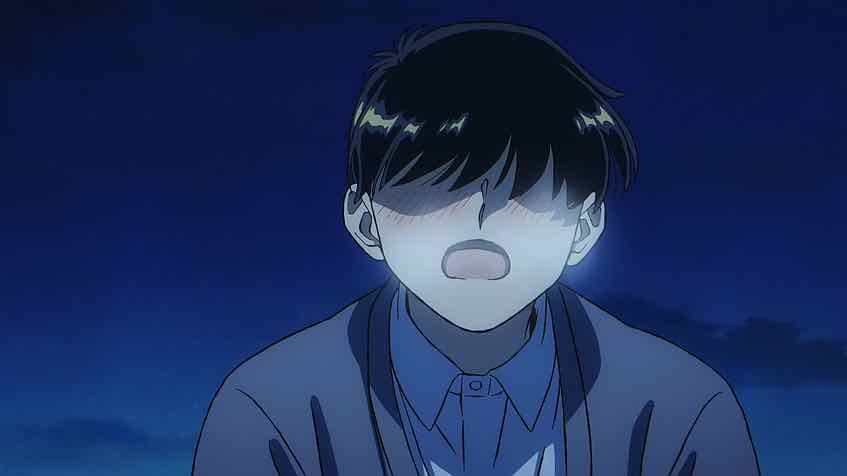
 That last one is a really critical question, it seems to me, and it’s central to the developments of this episode. Yes, it’s true as Nakamura says that “tomo-choco” has made it more acceptable for boys to give each other chocolate. But if Nakamura had given Hirose that box, he knows exactly what it means. And he can never bring himself to do it. He resolves to invite Hirose to walk home together after school the next week, and this time does muster the nerve to act on it. But Hirose demurs, saying he’s already committed to walking with someone else. And once Nakamura sees exactly who that is (Hana) it’s obvious who that someone is to Hirose.
 One of the best things about this show, I’ve always thought, is the way it depicts same-sex attraction as a perfectly natural thing. It doesn’t rely on subgenre tropes and check fan boxes. It’s a teen love comedy where the main character just happens to be gay. But ultimately this too is a contradiction, because there are very specific realities gay teenagers have to deal with that are unique to them. And that really came home to roost this week, in an extremely heartbreaking way (both for Nakamura and for us).
 Nakamura turning to Hifumi-chan’s doujinshi for solace is one of the most heartbreaking moments in the episode. It’s a fantasy – written by an artist who likes to fantasize about non-existent romances for personal gratification (and I mean that in a totally non-judgmental way). Ultimately he’s admitting that his life has been a fantasy all along. That in itself is part of the universality of the story – adolescent romance tends to follow that course. But to be rejected in this fashion – a sort of universal rather than personal rejection – is a very particular sort of experience.
 The last thing we see Nakamura confronting here is the selfishness of his own feelings towards Hirose-kun. He knows he should be happy if Hirose has found someone to make him happy, because if he values Hirose as a friend that’s how a friend should feel. But this is another painful realization for Nakamura – he’s always reduced Hirose to a literally romanticized version of a human being, not his true self. Who of course is someone Nakamura doesn’t really know. It’s easy to say you’ll be happy just being friends with someone you love, and be happy for their happiness. But in practice that’s a very difficult thing to do. And in romance terms, it doesn’t get much more universal than that.







robo
June 11, 2026 at 11:51 pmIt’s important to note that in the way home sad Nakamura sees only straight couples walking around, I believe that is a subtle way to indicate that Nakamura not only is facing a direct heartbreak but also complete alienation. That’s also part of the queer experience that’s highly relatable.