



 I hate to say it, but Shouwa Genroku Rakugo Shinjuu is almost as much of a curse for Akane-banashi as Seihantai na Kimi to Boku is for Koori no Jouheki (or maybe even Toshokan no Daimajutsushi for Tongari Bousei no Atelier). Is that fair? No. Even less here than with the two Koucha series, which at least have the same author. But Rakugo Shinjuu is so much better on every level that it’s hard not to grade on a curve here. Better writing, obviously – that would cover over 99% of series without exaggeration as good as it is. But also in terms of performance. And surprisingly, direction.
 Of course Hatakeyama Mamoru is one of the best directors in anime. But if there’s anybody who you’d think could have matched him, it would be Watanabe Ayumu. He has lesser building blocks to work with, sure. But also a much bigger budget even adjusted for inflation. It’s hard to put my finger on exactly what, but there’s just something missing with this adaptation. The rakugo just doesn’t pack any magic. I don’t think the seiyuu are nearly as good for the most part – again, obviously a very high bar there. But even though we get a bit more visual flourish in the performance scenes this time, they were still kind of flat. Fine – that cursed word again – just nothing special.
 I have to qualify that. One performance did have that spark – Kaisei’s, in Episode 2. That’s interesting for a couple of reasons, not least that Kaisei is Isshou’s apprentice, not Shiguma’s. But mainly because his seiyuu is not a seiyuu but a live-action performer, Shiono Akihisa. Shiono has an interesting background but there’s not any rakugo in it, as far as I can see. Nevertheless, his “Keikoya” was the one time in the series where I really felt swept up in the story being told. And it had a dangerous edge to it (as indeed does Kaisei himself) that elevated the moment considerably.
 This episode was again solidly competent, moving the story along in predictable fashion. Akane’s second pro gig (if you don’t count waiting on izakaya customers) is opening for Kyouji at a retirement community. And she’s learned her lessons from her debut. Her makura (I do love that this part of rakugo is literally “pillow talk”) is appropriate for the audience. She spots the one gent who seems disconnected and singles him out for eye contact. She starts slow (again with “Praising Children”) and eases her elderly patrons into her performance. She’s using her youth and cuteness as an entry point – as well she should.
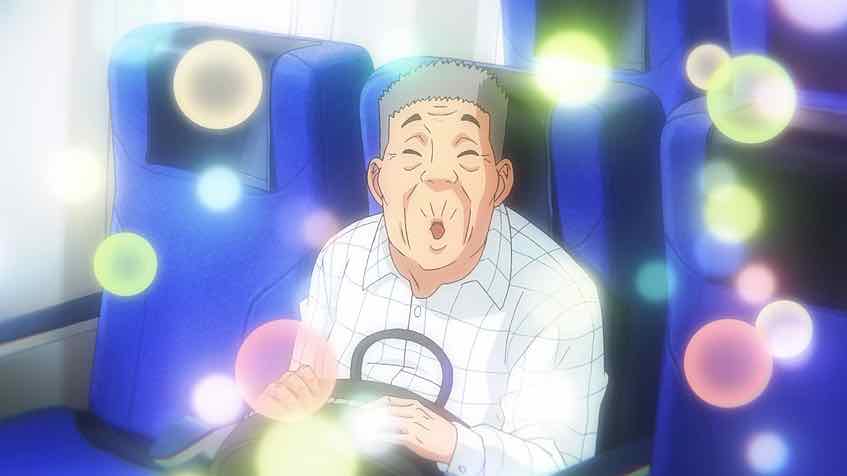
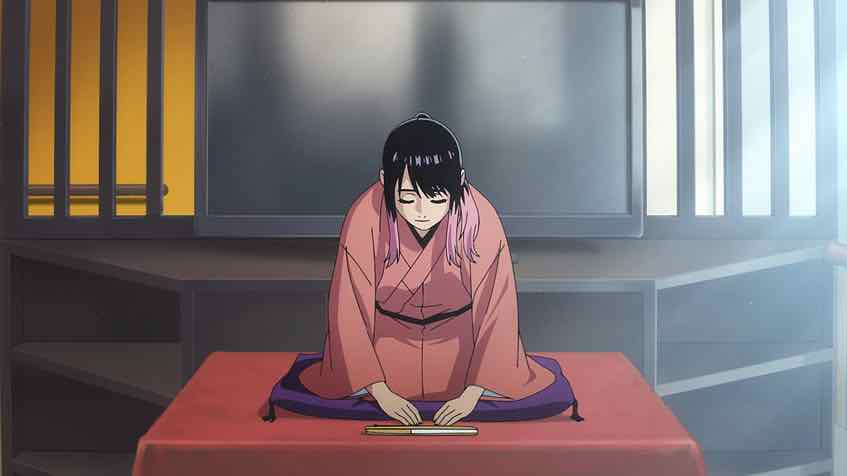 Kyouji then steps up to the plate. And he delivers “Three Men, One Ryo” which is truly one of the great all-rounder rakugo tales. The hook with Kyouji is that he’s a serious sort by nature, and “being funny” doesn’t come naturally to him. So Shiguma told him to trade on that. If seriousness is his identity, then the best way to make people laugh is by being too serious. It’s a nice idea but Azakami Youhei’s performance just doesn’t elevate the material. There’s no discernible sense of how this is any different from a rakugo just being funny. The direction does nothing to help with this – though to be fair, the way the scene is written in the source material is partly the issue, too.
 The most successful part of this sequence and episode is the way it communicates the depth of Kyouji’s feelings for Shiguma. Indeed this relationship between apprentice and master is a big part of Rakugo Shinjuu too, and one of the most interesting elements of rakugo. Shiguma is an important figure in the story – most critically, I think, in the way his apprentices feel about him as a person. The stuff going on around the periphery of the main story is always more interesting in Akane-banashi, almost without exception, and this is a prime example of that.









Henk
April 27, 2026 at 11:38 pmThe show is not really doing it for me, to be honest. So far it feels very ‘safe’ if that’s the right word.
Guardian Enzo
April 28, 2026 at 12:37 amI don’t object to that, LOL. The manga is very middle of the road – plucky heroine who always comes out on top that everybody loves, etc. It has charm but it’s very primary-colors and between the lines. What’s surprising is that the adaptation is so safe with Watanabe A-san directing it.