



 The fact that the best part of this adaptation for me is the OP and ED is perhaps telling – as an adaptation. Mainly of course it’s because Kuwata Keisuke is just that goddam good, and fits the material perfectly. But there is a frustrating reality here, which is that very little of Watanabe Ayumu’s style seems to be finding its way into Akane-banashi. I love vanilla ice cream, for the record. Simple can be superb, if the quality is high. But if I’m dining at a restaurant with a chef legendary for his flair and imagination, there’s going to be a certain letdown if he serves me vanilla ice cream for dessert on the tasting menu. No matter how good it is.
 That said this was certainly the best episode so far. Because, simply enough, it was the best material so far. Shiguma is always one of the strongest parts of this series whenever he’s prominent. He agrees to accept Akane as an apprentice, but only after she graduates high school. For now she can be a trainee (which in truth she’s been for six years). Shiguma is in a panic because of the guilt he feels over what happened to Shinta, and never having told Masaki about his training sessions. But she’s fine with it. She knew – because Akane “blabs about everything”. And while she nominally disapproves of her daughter’s career choice, she also knows it’s pointless to try and change Akane’s mind.
 The intro session with Shiguma’s futatsume is a bit rocky – three of them decline to supervise Akane’s training. But Kyoji agrees to take her on – sparing the newest, Guriko, so he can keep working on his own development. Kyoji rips Akane a new one for declaring she can ditch school whenever she wants, and promises to be a bit of a rakugo hardass. When he takes her to a performance he quickly reminds her of what a new apprentice’s role is – serving tea, straightening shoes, folding clothes, generally being obsequious. It seems hard to believe Akane would bristle at this, having grown up around rakugo, but bristle she does.
 The headliner that evening kindly offers to let Akane open the performance (note: everyone and everything accommodating her is a recurring theme). That’s annoying, but her performance more or less tanking is satisfying because of how realistic it is. It’s immediately obvious that she’s going way too fast and talking way too loud, never mind for an audience full of pensioners (as one suspects most rakugo crowds are these days). Kyoji equates it to a string of 93 MPH fastballs that miss the zone, and that pretty much nails it.
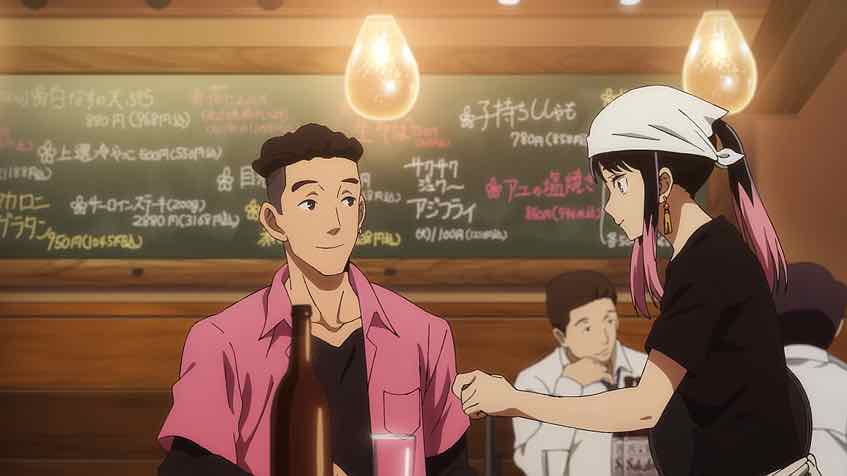
 Akane being obsessed with her own performance to the point of tunnel blindness is, in a word, expected. The reality of being 17 is that most people are governed by selfishness and impatience, with a healthy dose of arrogance. Most kids that age think mainly about themselves, want to get where they want to go without delay, and think they’re a lot smarter and more gifted than they really are. It’s not that they’re bad, they’re just teenagers. To give her a reality check Kyoji assigns her special training. To wit, working at Umi, an izakaya where he’s a (juice-imbibing) regular. And where the master, Miku-chan, is a veritable jihanki of valuable life’s lessons.
 This all happens too fast and too neatly, sure, but that’s just an Akane-banashi trait there’s no getting around. Especially where the title character and obstacles are concerned. Miku-chan certainly isn’t wrong in pointing out that failure in life is where good stories come from, and rakugo is all about good stories. That, and that she’s at the age where failing is perfectly fine and, if we take the long view, even desirable. It’s a nice and thematically relevant lesson and well-presented, light-speed or not.










Andy L.
April 19, 2026 at 10:06 pmI’m curious which Ayumu Watanabe works you most recommend.
Guardian Enzo
April 19, 2026 at 11:23 pmWow. Major 2nd, Summertime Render, Koi wa Ameagari, Uchuu Kyoudai, Nazo no Kanojo X to name a few.
catterbu
April 20, 2026 at 7:38 amWhile I definitely like Akane-banashi more than you — to me going up on stage as an opener, or getting a job serving food, feel mostly in keeping with what might happen with an exciting new 18 year old rakugo prospect and only a little convenient — I do think you hit on the directing being so vanilla. I think it was less of an issue this episode not just because the writing was better, but because what happened in this episode in particular. I think one of the most difficult transitions for manga to anime is when you have characters talking (or thinking) over action. In manga, this does not interrupt the flow of reading most of the time (unless it is just walls of text). It is easy to skip long explanations and focus on the panels, and read through one part, then another. Anime cannot do this.
In the first couple of episodes, we had performances that really were suppose to entrance us, but they were interrupted constantly by peoples thoughts and explanations. I think if Watanabe, or some other director, had spent a bit more time thinking about how to adapt the material, a lot of that explanatory dialogue would have been either eliminated altogether, or at least subordinated so that the viewer could focus more on the performance and get drawn in. The third episode had less actual performance and the whole point of the performance is how she is not considering the crowd, so it works for me that we get inside her head, and then have a little commentary establishing the poor performance before moving on. I know this was never going to be Shouwa Genroku Rakugo Shinjuu, but I do wish that future major performances would be allowed to breath a bit more.
Raikou
April 20, 2026 at 11:26 amThe thing about everything happens too fast and too neat is because Akanebanashi is serialied in Shonen Jump. Jump always focused on ratings so mangakas always make the story progresses too quickly so the protagonist seems to get straight wins and easy hurdles. Mangakas are afraid to be cancelled, and it’s affecting the stories.
I bet if Akanebanashi is on other magazines, Akane could develop the skills more naturally and had more losses than win.
I still like Akanebanashi, but this is the one thing that always bugged me about this series: too much of a straight win/smooth sailing plot.
Guardian Enzo
April 20, 2026 at 12:02 pmI certainly won’t deny that scenario exists. But it’s still up to the mangaka. I think if you look at Blue Box, Taiki’s progress has been realistically incremental. The writer has to have enough faith in the audience to go at that pace – which I admit is hard, when most WSJ series get axed after 20 chapters.
That may be a factor but I think Akane-Bayashiko is just temperamentally inclined that way. Akane is basically flawless and any obstacles will be removed from her path in very short order.
Simone
April 21, 2026 at 8:24 pmI feel like it’s a lottery. I’ve seen many good manga being axed seemingly for going too slow (but also many bad ones who rushed too much and then were axed anyway). But I do think compared to the past the average speed of any manga on Jump has accelerated.