


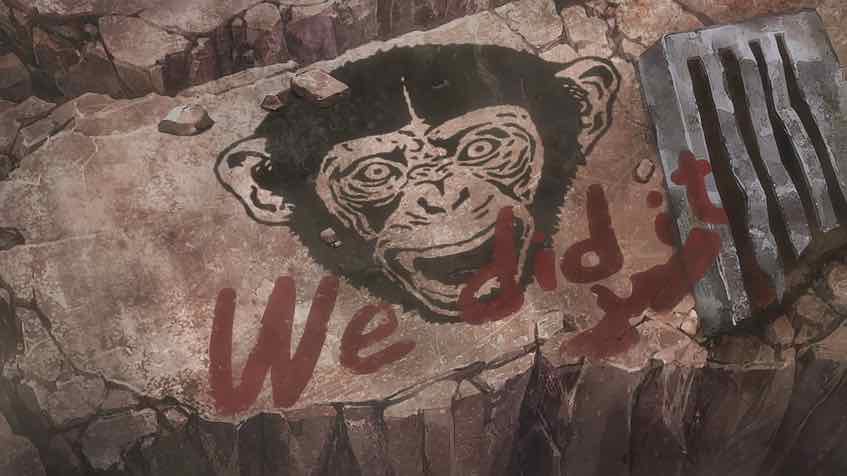


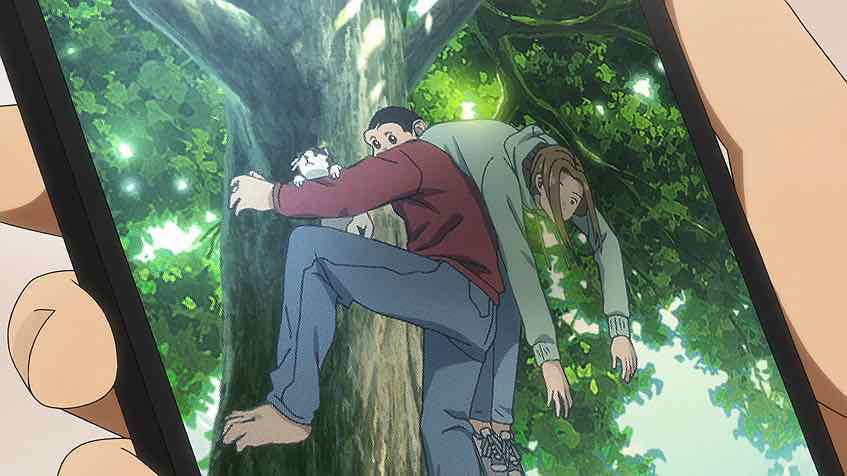
 There are some interesting things happening with Darwin Jihen already. Not least that it’s proving to be more well-reviewed in Japan than in the West. That’s interesting in and of itself, given that the story is set in the U.S. and the cast is almost entirely Americans. And not only that, I find it to be very American comic book-like in pacing and narrative style. What’s also intriguing to me is I kind of knew, somehow, that it would fare better with Japanese audiences and I’m not sure exactly why I did. Was it simply a matter of it having already won Japan’s biggest manga award, or was there something else I sensed here?
 The thing about The Darwin Incident is that the whole Midwest ‘Murica thing is just a little bit off. You can tell it was written by someone who doesn’t quite understand the setting. There’s no shame in that – if I set a story in Japan (I have, come to think of it) I’d absolutely project the same thing and more. It’s a pretty admirable attempt actually, but it’s just not quite right. As an American and a Midwesterner at that, I certainly see it. Sometimes it kind of annoys me, but other times I find it fascinating – this slightly tilted view of the place where I grew up. I certainly don’t think many Japanese people would be able to tell the difference, which is at least partly the point.
 One needn’t be a native or a social scientist to know that the divides Darwin Jihen trades in definitely do exist. The conversation in the cafeteria is staged to prove a point, but if your view is what Ozzy and Trevor’s is, half of the American political establishment has your back. The problems Charlie encounters in school are entirely realistic in my opinion (and also metaphorical of course). And the whole thing with the ALA blowing up restaurants obviously doesn’t grease the wheels for him. Of course it’s unfair for Charlie to get lumped in with terrorists he has nothing to do with (or agreement with). But if we’re honest, that’s exactly what would likely happen.
 Structurally, I think the series treats Charlie effectively as an alien. He’s human in so many ways that count – he speaks like us, he lives among us, he learns and adapts. But emotionally, he gives you very little to go on. No matter how much reason he’s been given, he hasn’t shown anger. He seems not to take offense when he’s treated in an offensive way. In fact, he shows no overt emotion whatsoever – but does that means he feels none? He thanks Lucy for sticking up for him, which is a suggestion of an emotional response. His desire to stay in school could be chalked up to intellectual curiosity, but who are we to say whether or not loneliness plays a part in it?
 Because Charlie is how he is, Lucy is effectively a co-protagonist. She has to carry the full emotional load without much help from him, so Lucy has to be expressive (which not coincidentally she is). Lucy felt like a weirdo and an outcast, but Charlie arriving on the scene pretty much clued her in to stop feeling sorry for herself in that department. Because Lucy is clearly Charlie’s school shadow, Feyerabend immediately zeroes in on her (zygote she is, Lucy completely whiffs on his Beatles reference) as a means of getting to Charlie. The connection here is obvious – the ALA is the reason Charlie was exposed to the world in the first place. But Feyerabend clearly sees the enormous potential Charlie holds as a symbol of their organization.
 The organization he falsely tells Lucy – without fooling her – that he’s a part of is a real one, the Kornberg Institute. Charlie still goes there for checkups and Lucy joins him this time to report on what happened. During the visit Dr. Fowler, the chairman, suggests that Charlie visit his biological mother, who is of course a chimpanzee. Her name is Eva, and this meeting seems like the sternest test yet as to whether there are any cracks in Charlie’s impenetrable emotional facade.











ruicarlov
January 15, 2026 at 9:21 amIt does feel weird to seen an anime in such an American setting. Last one I remember was Heroman. And even though I don’t know much about America there’s a certain “off” feeling that didn’t get across as much in Heroman since that was a superhero-kind of story. But the concept of Darwin incident and everthing else is quite good.
Guardian Enzo
January 15, 2026 at 2:31 pmYeah, Heroman was sort of actively trying to be a fantasy version of America. DJ is absolutely trying to be a realistic one. And as I say, it does a decent job of it but it’s just “off” enough that it sticks out like a sore thumb to me.
catterbu
January 15, 2026 at 9:26 amQuick question Enzo. I would be curious where you look for Japanese critics. My japanese is not great at this point, but I think it is good enough to pair with the web browser translate feature and read what they are writing. I have found people American critics, but not Japanese ones. Also, it is interesting to see the response from people who are coming across this series first in anime form. My response to both the manga and anime largely aligns with you, and is consistent between the two, but it seems like more English speaking anime only people dislike it than with the manga,
Guardian Enzo
January 15, 2026 at 2:32 pmJapanese social media is one place I look. But you can also see a big difference in Japanese (like Anikore) vs. English aggregator scores.
Joshua
January 16, 2026 at 7:39 amI think Darwin Incident is getting that acclaim in Japan because to them, it sounds like it’s tackling themes that sound like they’re deeply heated over in America because of how their culture is different to ours. It’s just that to us, this comes off very badly like a lot of political gesturing and not much actual throughline to commit to its politics like the author is writing down what he saw and heard in the news regarding culture war touching points over here and thought it was meaningfully topical stuff when it’s just grievance BS.
I shudder at the idea that this is supposedly a snapshot of the times.