


Of all the folks who support LiA, Collectr the Editor might be the most invested in the history of anime. Noted fansubber, editor, archivist – Collectr has had his hand in many pots. When Collectr suggested commissioning a piece on one of anime’s great “auteurs”, I was immediately interested. But also somewhat perplexed. Any undertaking on this front is a bit daunting, for starters. And then there was the matter of who to focus on. Not that there aren’t an embarrassment of rich choices, but who could I take on that would be both approachable and sufficiently monumental?
Collectr initially suggested Tezuka Osamu. And yes, I was intrigued by the idea. Tezuka is indisputably the most important figure in the history of anime and manga – it’s not a stretch to say he “invented” anime more than anyone else, though that was a collective process. But in the end I felt I couldn’t do Tezuka justice – there are too many gaps in my knowledge and understanding (despite his birthplace and museum being an hour-long train ride from me). Moving on from there, one name immediately jumped out as the obvious choice. Miyazaki Hayao is closer to my generation, an artist whose works I’m extensively (though not encyclopedically) familiar with and have written extensively on already. And Miyazaki is probably the second-most important figure in anime history.

I’ll say this, too – in America, Miyazaki is certainly more well-known than Tezuka, and Spirited Away or Totoro more than Astro Boy or Black Jack. For much of the world Miyazaki – and Ghibli, though mostly Miyazaki – was anime for a very long time. There’s irony in that given that he stubbornly tries to refute (with little success) the notion that his work is anime at all. Miyazaki is the only anime director to win as Oscar. And until the past few years, his films were the only anime theatricals to succeed at the American box office. As mainstream as it is in the West now it’s hard to believe, but for most of its history Miyazaki’s films were the only anime most people had ever seen.
There’s a reason why the Japan film world was obsessed with the idea of a “next Miyazaki” for so long. Any time that conversation happens – never mind when it’s huge names being bandied about – you know the subject has tremendous stature. Shinkai Makoto – who broke the Ghibli monopoly in the U.S. box office – Hosoda Mamoru, Hayao’s luckless son Goro – all had the mantle attached to them at one point or another. For various reasons it was ill-fitting on all of them. Goro, in his defense, was never that motivated to be a serious filmmaker – it’s his name that caused him to be thrust into this conversation against his will.

As to the other two, I think their careers are illustrative of just how remarkable Miyazaki’s is. Both Shinkai and Hosoda have seen the quality of their work decline pretty precipitously in recent years. With Shinkai he seems to be a victim of his own commercial success, which has boxed him into trying to create the nebulous zeitgeist of what a Shinkai movie is. Hosoda’s output has suffered after he parted ways with screenwriter Okudera Satoko, a move which exposed his flaws as a writer (flaws Miyazaki does not share). Shinkai remains a box office powerhouse (though to me there’s a bit of a zombie quality to this). Hosoda has seen a big decline there too, with his most recent – Scarlet – landing in Japanese theatres with a resounding thud.
With these two it goes deeper than this, of course. The biggest bump in the road to box office titan for Shinkai was when he blatantly tried to make a Miyazaki (who he deeply admires) movie in Hoshi wo Ou Kodomo (Children Who Chase Lost Voices). Hosoda did a stint at Ghibli and was initially slated to direct Howl’s Moving Castle before he left the studio over creative differences with Miyazaki (who wound up directing the movie himself). He’s the only one who actually was thought of as a Miyazaki successor in literal terms, albeit for a relatively short time.
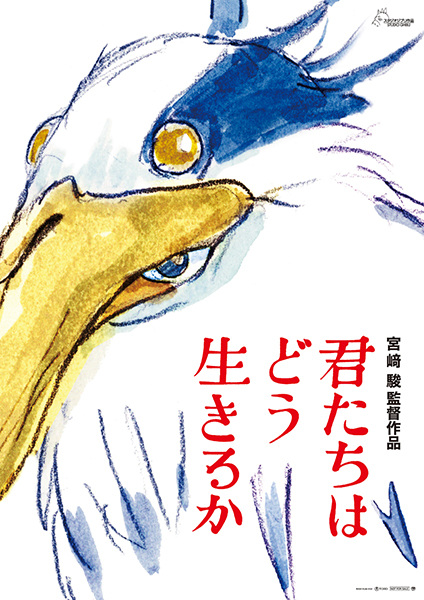
The creative struggles of these two younger directors only serve to highlight just how remarkable Miyazaki Hayao’s creative run has been. Kaze Tachinu and Kimitachi wa Dou Ikiru ka may not have been his greatest commercial or creative hits, but both are still critically admired blockbusters. He’s had no misses in his glorious Ghibli directorial career – only varying levels of hits. Takahata Isao is an auteur himself, and contributed several of Ghibli’s masterpieces. But Miyazaki is the reason why the studio is known and revered worldwide, and why it has a museum, a theme park, and a distribution deal with Disney.
There are so many angles one could take in trying to summarize Miyazaki’s career – far too numerous for a piece like this. His box office appeal – worldwide the movies he’s directed have grossed more than $1.6 billion. Spirited Away was the top-grossing Japanese film domestically for 20 years (until Kimetsu pipped it) and still is in inflation-adjusted Yen. His politics – Miyazaki is a pacifist and an environmentalist, often putting him at odds with the political mood in conservative Japan. The love of all things aeronautical, which pervades many of his works. His turbulent relationships with Takahata and producer Suzuki Toshio, and the remarkable story of the remarkable studio they built together.
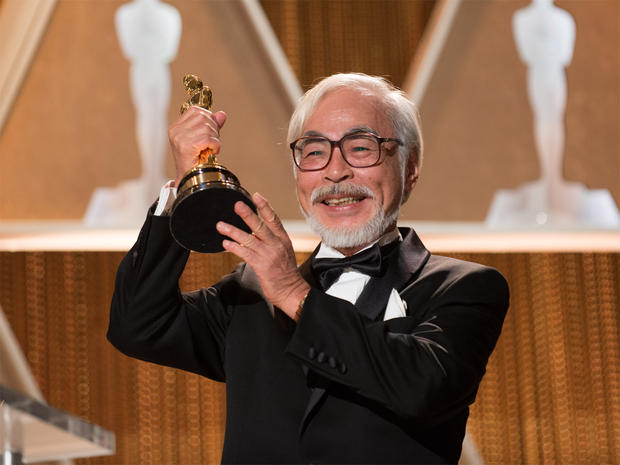
Any one of those themes could be the basis for a full-blown retrospective on Miyazaki Hayao. That’s not the nature of my task here. So how do I approach that task? A look at what I consider the best – or most important – of his works seems logical, but even that would be a big job. He’s written and directed twelve feature films and written three more, along with a myriad of shorts, several TV series, and over 15 manga (a part of his oeuvre that Western audiences know little about). That number of theatrical releases may not seem overwhelming in terms of sheer volume, but when you consider just how much Miyazaki puts into every one – personally storyboarding and approving every cel, and drawing thousands of them himself – it speaks to his workaholic nature.

As important as his other works are, I’m going to limit myself to the full-length films as they undoubtedly represent Miyazaki’s most well-known works. Even there choosing only a few – say, five – is a Herculean task. Chronologically I would start with 1986’s Tenkuu no Shiro Laputa (Castle in the Sky) – perhaps sacrilegiously skipping Nausica – because it’s the best example of Miyazaki’s affinity for flying and perhaps anime’s greatest expression of the steampunk ethic. He blends that in with a distinctly Mesoamerican visual subtext and a powerful character story that’s one of his most engaging. As a pure adventure film I rank Castle in the Sky at the top of the Miyazaki pantheon.

Laputa is also important because prominent in it is a recurring theme of Miyazaki’s films – anti-colonialism. Some might even say it extends to Luddism, but I would disagree – and indeed, his fascination with aircraft (the obvious central pillar of Laputa) stands in stark contrast to that notion. Miyazaki strongly believes mankind should co-exist with nature, and decries the impact much of technology has had on our species and planet (he’s been a loud skeptic of AI and its impact on the creative world). But he’s no Luddite, as his catalog affirms.

Next I would cite Tonari no Totoro (1988), the follow-up to Castle in the Sky. Spirited Away has the Oscar and the bigger box office, but I would argue this is the movie that most exemplifies both Ghibli and Miyazaki. It’s the one in the studio logo. It’s the one whose theme song every Japanese person from three to a hundred knows. In short, I would argue My Neigbor Totoro has had a greater cultural impact than any other Ghibli film. It’s a dark children’s story in a sort of Platonic ideal form.

Next (skipping Kiki and Porco Rosso, themselves incredibly influential) we come to Mononoke Hime (1997). I have a bias here, in that this movie as much as any was instrumental in making an anime fan out of me. Even seeing it with an English dub I was absolutely gobsmacked – when I saw it in the original Japanese (with 20 minutes of footage missing from the original dub cut restored) even more so. This is the pinnacle of Miyazaki’s catalog for me, and quite probably the finest anime film ever made.
In addition to its sheer visual scope and imagination, Princess Mononoke is an intellectually dense work that profoundly reflects Miyazaki’s views on environmentalism and the exploitation of native peoples. Until his “final” (for now) two features, it was the most expressly adult film he directed. I know I’m not alone in my reverence for it – this movie made anime fans of a lot of people, including those who would go on to prominence in the American animation industry. If I were to choose one truly indispensable Miyazaki work, Mononoke Hime would be the one.

I can’t possibly leave out Sen to Chihiro no Kamikakushi, Spirited Away (2001). In real Yen it remains the top-grossing domestic Japanese film of all-time, and it’s the only anime ever to win the Academy Award for Best Animated Feature. It also featured the debut of then 13 year-old Inino Miyu as Haku, launching the career of one of anime’s greatest seiyuu. All of Miyazaki’s major themes are here – environmentalism, anti-consumerism, Shinto mythology – paired with probably his most approachable plot. It’s the great all-rounder in the Ghibli filmography, and probably represents the “first anime I ever saw” for more Westerners than anything else.

Finally, we come to what I suspect will be the most unpopular among the five choices, 2013’s Kaze Tachinu (The Wind Rises). Objectively, I would probably not rank it among Miyazaki’s best works in terms of pure narrative execution. But given its subject matter and the point on the Miyazaki timeline on which it resides, it may be the most interesting of all. I wrote extensively about it here. In all honestly I would probably assess that review as the best I’ve written in terms of pure criticism. And that’s not because of me, it’s because The Wind Rises is such an incredibly vexing and thought-provoking film.
Kaze Tachinu seems at once to be both a biography of someone else (Horikoshi Jiro) and an autobiographical film. And given the circumstances of its production, the autobiographical side reads as a reflection at the end of a career (though Miyazaki would un-retire yet again to direct How Do You Live?). It’s also notable because for me it represents the apotheosis of Miyazaki’s partnership with his musical muse, the great Joe Hisaishi. For me this is Hisashi’s greatest Ghibli score, as high a bar as that is. It’s also the film where his music feels most inseparable from the story.

Anytime one reflects on Miyazaki Hayao these days, the elephant in the room is whether it’s a career retrospective. Miyazaki is legendary (or notorious) for his false retirements. He’s done at least three to date, and at this moment there are no links as far as I’m aware to another theatrical project. He is as noted a workaholic, and the fact that indeed no “next” has stepped up to fill his unfillable shoes more or less means the future of Ghibli still hangs on his creative output. But Miyazaki turns 85 in January, and the gap between his last two feature films was a decade. It seems likely that this retirement is the real deal.
When I reflected on How Do You Live, it was a bittersweet experience, tinged with the knowledge that it was likely Miyazaki’s final film. If The Wind Rises was his retrospective of his career, this was that of his life. Ghibli producer and Miyazaki altar-ego Suzuki said that in his view it represented a letter from the director to his grandson, to help him understand the meaning of life – and death. One cannot look back on this body of work without lamenting that it can’t continue to be expanded forever. Anime has never seen the like, sure, but neither has film itself.




Collectr
December 29, 2025 at 1:59 amAh, Princess Mononoke… even today, after a new dub with no cuts, it needs to be watched in Japanese with subtitles. The other modern dubs, many done under John Lassiter’s auspices, use translations; Mononoke, done by Mirimax, uses an adaptation by Neil Gaiman. I love Gaiman’s work, but he minimizes the film’s animism and alters the character of the Jigo-bou, the conniving monk, quite a lot. It’s a fine film in English, but a better one in Japanese.
Porco Rosso has the same obsession with flying, particularly Italian seaplanes, as The Wind Rises. They share the same poetic image of dead pilots and destroyed aircraft rising to the heavens in an arc of points of light. And it has Miyazaki’s most overly political line: “Better a pig than a fascist.” It deserves to be better known among Western audiences.
Joe Hisaishi points out that American audiences expect more scoring in their movies than Japanese audiences. He expanded the Laputa socre drastically for the US release, to the point that the US release soundtrack is quite distinct from the Japanese one.
So many points to think about and discuss… so few column inches. In any case, thanks!
Guardian Enzo
December 29, 2025 at 5:39 pmThank you, sincerely. As you said, so many points to discuss. That was one of the longest pieces I’ve done for LiA in years and I feel as if I barely scratched the surface.